
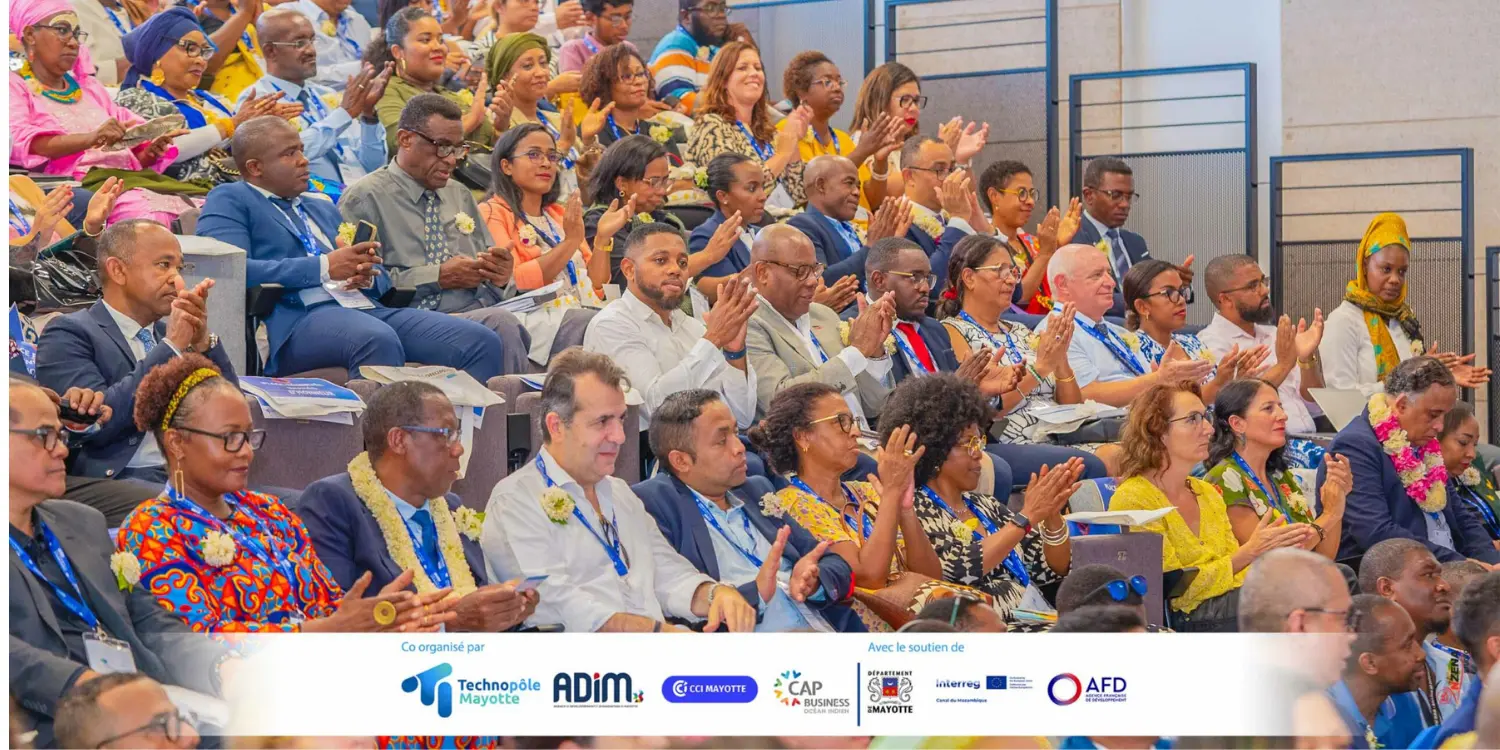
The 14th edition of the Forum Économique des Îles de l’Océan Indien was held from 5 to 7 November in Dembéni, Mayotte. Co-organised by Cap Business Océan Indien and the Agence de Développement et d’Innovation de Mayotte (ADIM) in conjunction with the Association Mayotte Technopole and the Chamber of Commerce and Industry of Mayotte, this event once again proved to be the leading regional gathering dedicated to private sector economic cooperation. It received support from the Agence Française de Développement (AFD), the Department of Mayotte, and the Interreg Mozambique Channel programme.
This edition brought together, within the brand-new Mayotte Technopole, experts, decision-makers and economic stakeholders from Madagascar, Comoros, Mayotte, Seychelles, Reunion and Mauritius. In addition to the six territories of the South-West Indian Ocean basin, representatives of territories on the African continent such as Kenya and Mozambique, and of the European Union, strategic markets for trade in the Indian Ocean region, were also present.
Prospects for sustainable economic development through strengthened cooperation and the optimisation of regional resources were explored.
A central theme: “Produce Regional”
Under the theme “Produce Regional”, the forum highlighted the considerable potential of the region, rich in its cultural, environmental and economic diversity, which offers a solid basis for the development of regional value chains. Local production was at the heart of the discussions, both to reduce dependence on external inputs and to maximise opportunities on international and regional markets.
Day 1: An opening rich in perspectives
The first day began with an official ceremony followed by an inaugural session marked by addresses from influential figures, including: Dr Baomiavotse Vahinala Raharinirina, senior lecturer at the University of Fianarantsoa and former Minister of Environment and Sustainable Development of Madagascar, Jean-Claude Brunet, Ambassador Delegate for Regional Cooperation in the Indian Ocean zone, and Florence Mar Picart, Director of the Institut d’émission des départements d’outre-mer in Mayotte.
These addresses, focusing on the creation of shared value chains for the green and blue economy while protecting and enhancing resources, on economic and environmental resilience in the face of climate change, on the economy and regional opportunities such as making the Indian Ocean a global pharmaceutical laboratory by valorising the region’s medicinal plants, and on moving beyond siloed approaches to build a strong and unified regional identity, paved the way for discussions.
The round tables and workshops made it possible to delve into key themes. Among them: the extension of OHADA law (Organisation for the Harmonisation of Business Law in Africa) to the South-West Indian Ocean. This initiative aims to strengthen economic integration and business ties between our island territories. Secondly, dependence on non-regional agricultural inputs, a critical challenge for the islands, addressed with solutions focused on sustainability and resilience. Thirdly, tourists as consumers of regional products, highlighting the role of the tourism sector in promoting local products. Finally, sustainable packaging and storage in the tropics, with a particular focus on innovative and environmentally friendly solutions.
The first day concluded with B2B meetings and a welcome cocktail, encouraging informal exchanges between participants.
Day 2: Ecological transition and regional connectivity
The second day explored in greater depth the opportunities offered by an ecological transition. The debates focused on creating high value-added products through sustainable and innovative practices. Discussions covered in particular: improving air links to the islands, essential for connecting regional production basins to international markets. Then, maritime routes, the true backbone of regional trade, and their strategic role in the transport of goods.
Workshops: from crafts to human capital
Regional crafts were at the centre of discussions, with a workshop exploring ways to develop this sector while preserving natural resources. Entrepreneurs and experts shared their experiences and the solutions explored to address the challenges they faced. In addition, another workshop highlighted the importance of investing in human capital to strengthen regional competitiveness. By identifying training needs and placing people at the centre of strategies, this workshop paved the way for a sustainable upgrading of local products.
The second day also featured a round table dedicated to the Varuna programme, supported by the Agence Française de Développement and implemented by Expertise France. Inspiring initiatives aimed at halting the erosion of biodiversity in the South-West Indian Ocean. Ten exemplary projects, led by private companies in collaboration with civil society organisations, demonstrated how to reconcile economic growth and environmental preservation. This session also helped strengthen dialogue between businesses, funders and associations, an essential lever for sustainably integrating biodiversity into economic strategies.
Day 3: Start-up pitches, company visits and closing
Participants had the opportunity to visit four local sites or companies, including the Mamoudzou Data Center, the Port of Longoni, the Akuo photovoltaic site and the Pôle d’Excellence Rurale. These first-hand observations highlighted initiatives in regional production, sustainability and economic development. These visits also enabled the sharing of knowledge and know-how through B2B exchanges. It was also a time for strengthening synergies between our territories and creating partnerships to reinforce regional collaboration.
Innovation and circular economy
On the subject of innovation-focused initiatives, a round table on energy self-sufficiency provided an opportunity to reflect on decarbonisation strategies adapted to local realities.
Another highlight of the day was the regional visibility given to several young companies from various fields such as tourism, the circular economy, agriculture and technology. These innovative start-ups from the Indianoceanic region, seeking to accelerate their growth and strengthen their partnerships, were able to promote their projects, paving the way for new regional production opportunities through innovative technologies or business models. The Circular Economy Fresk workshop, for its part, underlined the need to transform linear models into circular systems.
A success for regional cooperation
Spread over three days, the 14th Forum Économique des Îles de l’Océan Indien brought together more than 250 participants at its peak, offering a rich programme: eight round tables, seven workshops, more than 50 speakers and more than 80 B2B meetings. A participation rate that confirms the importance of regional cooperation in meeting common challenges and seizing development opportunities. By fostering the exchange of ideas, strengthening partnerships and promoting local resources, the forum charted a clear path towards a sustainable economic future for the region.
We therefore look forward to meeting again next year in Comoros for the 15th FEIOI, which will be hosted by the Union of Chambers of Commerce, Industry and Crafts of Comoros (UCCIA), with the renewed ambition of building a prosperous and united future for all the islands.

Lorem ipsum dolor sit amet, consectetur adipiscing elit. Ut elit tellus, luctus nec ullamcorper mattis, pulvinar dapibus leo.