
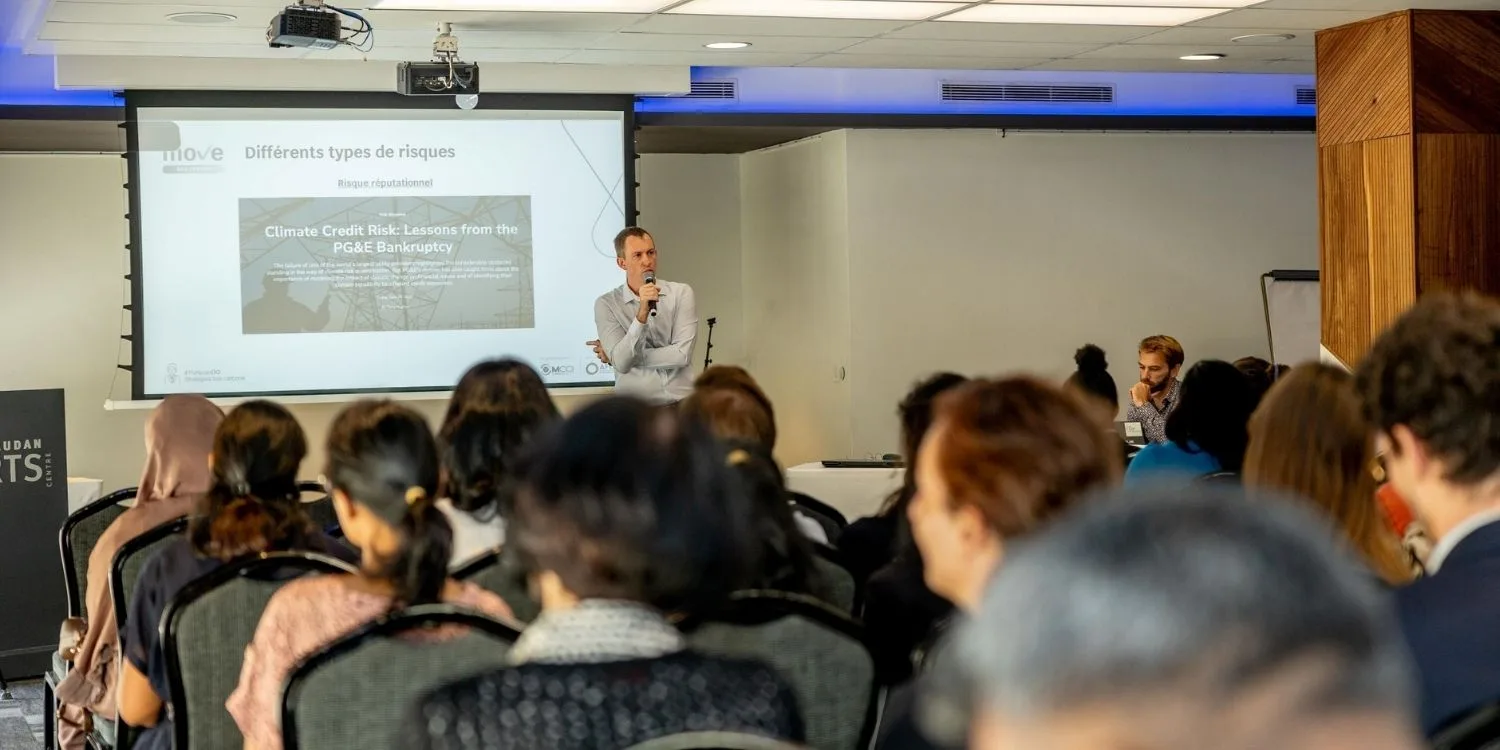
Cap Business Océan Indien launches The Move: supporting change, a new tool to help regional companies in their transition towards fairer, more sustainable and more resilient economic development. This first edition, focusing on low-carbon strategies, was supported by the Mauritius Chamber of Commerce and Industry and comes at the close of the Carbon Footprint Project, co-financed by the Agence Française de Développement, which lays the foundations for a collective dynamic towards the decarbonization of the regional economic fabric.
1st low-carbon edition of The Move
The first edition of The Move, dedicated to low-carbon strategies, was launched on 15 May 2025 at the Caudan Arts Centre in Port Louis, as part of the closing ceremony of the Carbon Footprint Project, led by Cap Business Océan Indien and co-financed by the Agence Française de Développement (AFD).
The morning, reserved for the Low-Carbon Working Group, provided an opportunity to take stock of the project and to share lessons learned and prospects for the pilot companies in the region. The afternoon featured a conference on climate risks to raise economic operators’ awareness of the vulnerabilities and impacts of climate change on their activities, particularly in terms of physical, liability and transition risks. To close the day, Benjamin Vegar, head of the consulting firm Carbone Ingénierie, presented the results of a pre-feasibility study on the creation of a carbon offsetting standard for companies in the region.
In a global context marked by major climate disruption, the island countries of the Indian Ocean face heightened vulnerability and significant energy dependence. Given the structural challenges that the ecological transition represents for businesses, Cap Business Océan Indien took the lead by implementing the Carbon Footprint Project, which aims to carry out carbon footprint analyses of companies and associated reduction plans in the South-West Indian Ocean.
The Carbon Footprint Project
Nearly a year after its launch in June 2024, this project has raised awareness among the 50 pilot companies in the region (Mauritius, Madagascar, Comoros and Seychelles) of energy and climate issues, and supported them in their transition towards decarbonized and more resilient business models.
These pilot companies benefited from an analysis of their carbon footprint covering Scopes 1, 2 and 3 across their entire value chains (using the Bilan Carbone® tool); the co-construction of plans to mitigate their greenhouse gas emissions; and training in the tools used. The project also analyzed the pre-feasibility of a regional carbon offsetting standard in the Indian Ocean.
This project also stands out for its high standards, notably through the systematic inclusion of Scope 3 and rigorous documentation of the data, assumptions and emission factors used.
The co-construction workshops mobilized company teams (managers, sustainability leads, innovation managers, etc.), with strong commitment from senior management. This participatory approach strengthened the companies’ carbon governance.
A two-part training phase also strengthened the companies’ internal capacity to carry out a carbon footprint assessment in line with international standards, with a precise methodological framework for future exercises. The first part consisted of collective online sessions offering three two-hour modules to introduce companies to carbon footprint methodology and the development of a decarbonization pathway. The aim was to enable exchanges between the different companies involved. The second part included in-company support to improve the data collection process through a “gap analysis”.
Measurable actions
The project resulted in the consolidation of 140 actions representing a reduction potential of more than 250,000 tonnes of CO₂ equivalent by 2030. The main emission sources targeted are:
“The private sector now has the keys to be an actor in the structured and sustainable economic transition of our region. This is a strong gesture of climate responsibility,” said Guillaume Hugnin, President of Cap Business Océan Indien.
Vincent Hornsperger, Low-Carbon Strategies and Circular Economy Officer at Cap Business Océan Indien, explains: “This project marks a step forward for the private sector by offering a structured methodology on regional low-carbon transition issues, in particular on carbon accounting in line with international standards, with the integration of Scope 3 into the calculations, including indirect emissions across all the value chains analyzed. Companies will thus be able to align with European regulatory requirements and carry out their carbon ‘reporting’ as part of their annual sustainability report.”
“Given the climate emergency and the specific vulnerabilities of island territories, it is essential to support companies towards low-carbon development pathways. The Carbon Footprint project fully embodies this ambition: it combines methodological rigor, regional cooperation and the upskilling of economic stakeholders. By supporting this initiative, AFD reaffirms its commitment to co-constructing, with its partners, concrete solutions for a more resilient, fair and sustainable economy in the Indian Ocean.” Patricia Aubras, AFD Regional Director for the Indian Ocean.
For his part, Dr. Drishtysingh Ramdenee, Secretary General of the Mauritius Chamber of Commerce and Industry, emphasizes: “This edition of The Move represents a valuable opportunity for Mauritian companies to integrate low-carbon strategies into their development. This initiative responds to current sustainability challenges and enables economic stakeholders on our island to prepare effectively for new international requirements. The MCCI actively supports this project, which makes a concrete contribution to the ecological transition of our business community.”
12-month coaching programme
The majority of companies expressed their wish to continue this support until their next carbon footprint assessment. In response, to ensure lasting support for companies in their decarbonization strategy, Cap Business Océan Indien is launching a 12-month post-carbon-footprint coaching programme. This essential support for moving from diagnosis to impact is open to companies already involved, but also to new players wishing to benefit from a group dynamic. This support will be provided through a Regional Low-Carbon Working Group, and will offer personalized support, as well as the capitalization of the programme’s results in June 2026.
With this first structuring step, Cap Business Océan Indien confirms its commitment to a more sustainable regional economy. The Carbon Footprint Project lays the foundations for a collective pathway towards the decarbonization of our island economies and provides a solid first basis for future initiatives in the Indian Ocean. Awareness-raising actions must continue in order to strengthen the awareness and commitment of economic stakeholders towards new, more sustainable business models. A key lever for mobilizing more companies will be to showcase the results achieved through this project.
“The profile of the companies supported during this project shows a certain diversity among the stakeholders involved, with 14 sectors represented. However, to be more representative of the economic fabric of the Indian Ocean area, it will be worthwhile to include new sectors of activity (textiles, hospitality, fishing for example) and to strengthen geographical coverage,” concludes Vincent Hornsperger, Low-Carbon Strategies and Circular Economy Officer at Cap Business Océan Indien.
In the long term, one of the expected outcomes would be to capitalize on the data accumulated from several sectoral carbon footprint assessments, in order to develop representative and reliable local and/or regional emission factors. The more mobilization expands, the more the capacity to decarbonize sectors of activity will be strengthened at regional level.

Lorem ipsum dolor sit amet, consectetur adipiscing elit. Ut elit tellus, luctus nec ullamcorper mattis, pulvinar dapibus leo.