
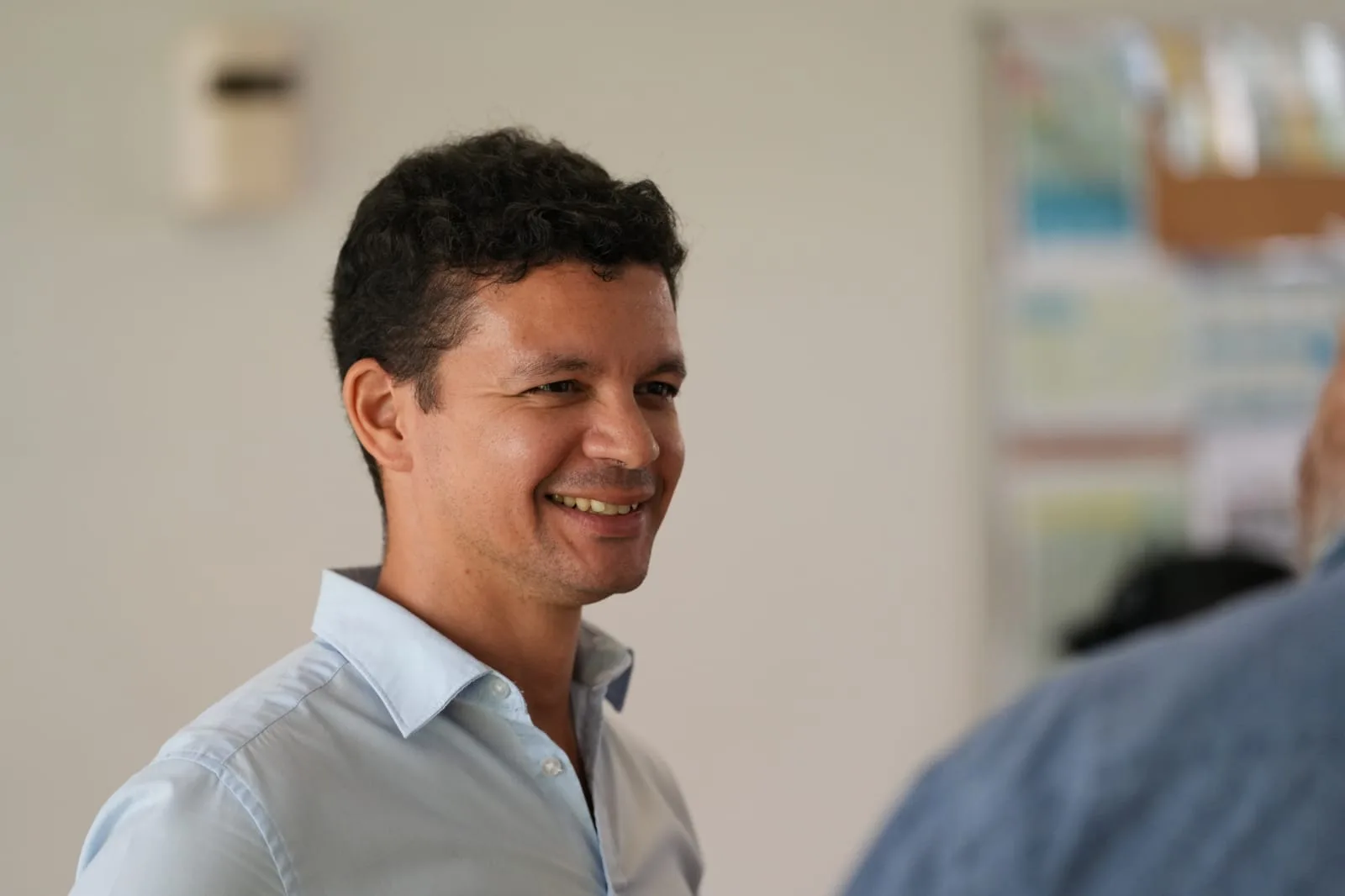
In this interview, he looks back on this event dedicated to biodiversity and takes the opportunity to take the debate further, sharing his vision of an agricultural transition that builds resilience for our territories.
What key messages do you take away from the conference-debate on agriculture and biodiversity?
First, the consistency of the testimonies. The discussions showed both the need for such spaces for dialogue and the concrete solutions that emerge from them. To successfully transition our agricultural models, this sharing of collective intelligence is essential. These platforms make it possible to compare experiences, better understand common challenges and strengthen integration between initiatives in the sector.
Why is agroecology an essential lever for preserving and restoring biodiversity?
Agroecology rests on three pillars: economic, social and environmental. It offers a systemic approach that puts biodiversity back at the heart of our models of production, consumption and land-use planning.
It is an approach inspired by nature and its interdependencies: between species, soils and biotopes. It makes it possible to better manage cycles, deficiencies and climate hazards.
How is the Mauritian agricultural sector evolving in its relationship with biodiversity?
Mauritius has always had forms of agroecology, often based on empirical knowledge: the use of companion plants, the introduction of species to control pests, maintaining soil life… These practices were somewhat lost with the rise of monocultures, but today we are seeing renewed interest.
Our association is seeing a growing number of professionals eager to develop their skills. Within this momentum, we are also noting the emergence of regional projects that make it possible to compare approaches, practices and solutions. These complementary synergies prove that a transition adapted to our local realities is possible.
What are the main obstacles to this transition today?
They are mainly structural. Mauritius has developed little in organic farming, and regulatory frameworks remain limited. It is therefore essential to legislate to create a clear space dedicated to sustainable agriculture, without strictly copying European models which, through their rigidity, would hold back the transition. Agroecology can broaden the range of possibilities by providing solutions consistent with the local context. Because agroecology is more than a farming method: it is a societal project that links economic performance, ecological resilience and social equity.
What role does Terres d’Agroécologie play in this dynamic?
We work on three fronts: training, experimentation and promotion. We train based on real field situations, so that learners experience the practices first-hand. We also support producers across the entire chain: design, technical development, alternatives to chemical inputs, and marketing.
Our label, “Terres d’Agroécologie”, is notably a promotion tool awarded on the basis of comprehensive audits. It assesses risk management, the traceability of inputs and the overall consistency of practices. Three farms have already been certified and around ten others are in the process of certification. It is a demanding process, but it guarantees the credibility and quality of the initiatives undertaken.
Beyond the agricultural sector, how can regional cooperation on biodiversity be strengthened?
There are already many initiatives in our territories – in applied research, entrepreneurship and rural development – but they remain too scattered. Better connecting these projects would make it possible to identify and disseminate good practices more effectively.
We also need to rethink financing models. Coming mainly from foreign investment, they would benefit from being relocated or regionalised. I therefore emphasise the central role of the regional private sector community in this dynamic. It has capital, skills and the capacity to support initiatives with international potential, even when they start at the local level. Beyond its capacity to set up projects, it carries weight in public decision-making and can unite to mobilise major donors, who are often reluctant to prioritise our small territories. Demonstrating the viability of models that can be replicated elsewhere is therefore of strategic interest to all these stakeholders.
And what about technological innovation? Can it serve the agroecological cause?
Some technologies can simplify agricultural work, but they are often designed for large monocultures. In more diversified systems, they need to be rethought. Low-tech has real potential: accessible, adaptable and useful for collecting and sharing data between farms.
As a sustainable development strategy for our territories, agroecology reconnects production, biodiversity and the economy, paving the way for more resilient agricultural models that create value and balance for generations to come.

Lorem ipsum dolor sit amet, consectetur adipiscing elit. Ut elit tellus, luctus nec ullamcorper mattis, pulvinar dapibus leo.