
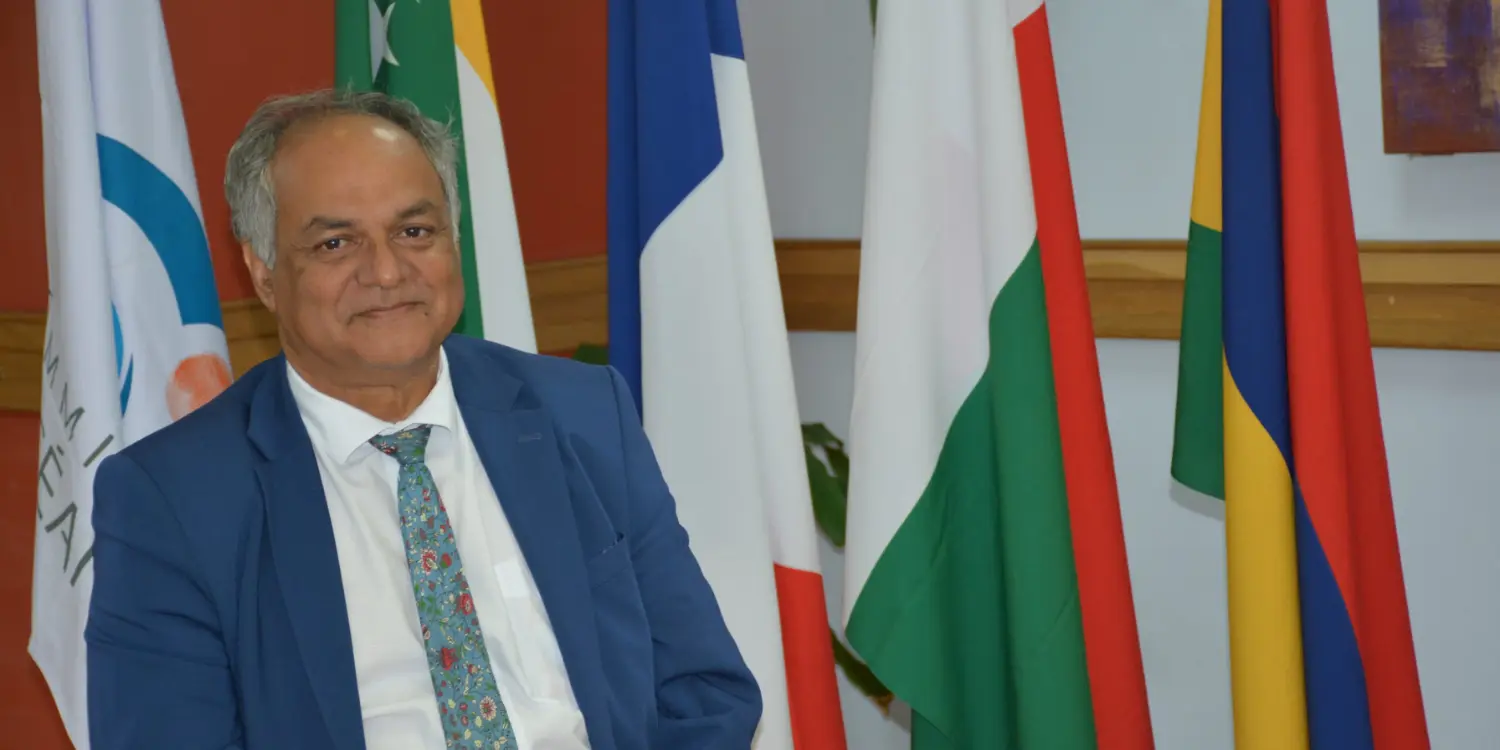
Interview with the Secretary General of the Indian Ocean Commission, Prof. Vêlayoudom Marimoutou.
What will be the impact of the war in Ukraine on our island economies? This is a question that concerns political and economic decision-makers in the region. In this interview, Prof. Vêlayoudom Marimoutou, Secretary General of the Indian Ocean Commission (IOC) and an economist by training, shares his analysis of the repercussions of this conflict on our region and puts into perspective the challenges we must address.
In the face of the repercussions of the war in Ukraine on their economies, the governments and local authorities of our territories are taking action, but each on their own. In your view, is a regional response strategy conceivable?
For our territories, trade with Russia and Ukraine is limited in volume, but it can be strategic (food imports, particularly cereals). Supply chain disruptions caused by the conflict or by sanctions could lead to supply difficulties. Some territories (Seychelles, Mauritius, …) are likely to be affected by the decline in tourism revenue from Russia and Ukraine.
The war in Ukraine is a new shock on top of the aftershocks of the pandemic. It is a brake on recovery. The impact of the war in Ukraine confirms the relevance and added value of regional channels for exchange, trade and production, as the Covid-19 pandemic had already shown.
Overall, responses need to be built at national level by mobilising economic stakeholders and supporting the search for more competitive suppliers and promising new markets. The States of the region have every interest in cooperating more closely on economic and trade matters, both bilaterally and multilaterally. We can indeed consider a regional mitigation strategy rather than a response strategy. But this strategy must go beyond the immediate circumstances and become a structural element of national economic policies: regionalisation, through the strengthening of economic and trade ties, the complementarities between economies and their comparative advantages, is undoubtedly one of the answers.
To what extent can the IOC intervene to support States and populations during this difficult period?
The IOC intervenes at the request of the States, according to the roadmap it is given and the resources it can mobilise from its partners. The IOC essentially provides support over the long term rather than in the very short term of a difficult period such as this one.
It is in this spirit that we engage national and regional stakeholders on a range of issues. Regional connectivity – air, maritime and digital – is a key structural issue. On the digital front, results have been achieved, notably with the commissioning of the METISS cable. On the maritime front, the IOC, with the support of Japan, is bringing together stakeholders from the region, including Cap Business Océan Indien, the Port Management Association of the Indian Ocean Islands and the Port Management Association of Eastern and Southern Africa, to identify ways to improve the competitiveness of maritime transport. I also note with satisfaction that the Mauritius Exporters Association is raising the question of a regional maritime cabotage system.
There is also the issue of food and nutrition security. The production potential exists in each of the islands. There is also potential for trade in foodstuffs, for agri-food processing and for rediscovering production that has been, if not forgotten, at least neglected. A regional strategy is one thing, but it must be fully owned by the States, and the conditions for its implementation must be secured: regulation, competitive costs, public-private partnerships…
Rising freight, oil and food prices… How do you assess the impact of the inflationary trends looming in our territories?
Most economies are weakened by rising prices for hydrocarbons and agricultural commodities. Since the start of the conflict, the price of a barrel of Brent has exceeded USD 100. Moreover, the conflict is accentuating the upward trend in wheat prices observed since mid-2021: the increase between early January 2022 and 11 March reached 40%. The combined rise in hydrocarbon and cereal prices could weaken our economies through several channels. First, the inflationary impact is stronger than in developed countries because fuel and food account for a large share of the average consumer basket. Rising global commodity prices will severely affect people’s purchasing power as well as local production costs.
Second, pressure on prices will leave central banks less room for manoeuvre to pursue a flexible monetary policy, and pressure to raise key interest rates is likely to intensify, whereas until now the fragile nature of the economic recovery and weak demand-side pressure on prices have contributed to a moderate tightening of monetary policies. In addition, higher interest rates in developed economies spill over into developing countries, as the central banks of these countries maintain positive interest rate differentials to attract portfolio inflows, particularly in the bond market. There are fears that a recession could soon spread from Europe.
Weaker growth prospects for non-hydrocarbon-producing countries, combined with higher interest rates, would put significant pressure on public finances by increasing domestic and external borrowing costs. At the same time, fuel and cereal subsidies exist in most countries, at an already high cost that will become even heavier, against a backdrop of deteriorating public finances linked to the Covid-19 crisis.
The direct impact on people’s purchasing power, together with the increased budgetary constraints on States, could be a source of significant social tensions. The resulting deterioration in public finances could indeed hold back public investment and social spending in a context of high indebtedness in many States.
In your opinion, which sectors will be hardest hit if the crisis continues?
All sectors that depend on imports of raw materials, such as agri-food, or of finished products, such as construction. Tourism will also suffer again, especially as our main markets are in Europe. The cost of air transport could make our destinations less attractive unless we opt for a common approach to gain competitiveness. It is the Indianoceania product that could be promoted, rather than competing destinations that are in fact complementary. This is the whole purpose of the Vanilla Islands Association. It was also the ambition of the Vanilla Alliance of air carriers launched in 2016 under the aegis of the IOC. But the prevailing logic is one of competition rather than synergies and partnerships…
Above all, we must recognise that our islands are too vulnerable to exogenous shocks, so most value chains will be affected.
To what extent could stronger economic cooperation between private stakeholders make us more resilient in the future?
Businesses create wealth and jobs. They are the strong and willing horse that pulls the cart, as Churchill said. Closer cooperation between the region’s economic stakeholders is needed to create regional value chains that will be better able to withstand external shocks. There is an opportunity to create added value at regional level.
Resilience also depends on stronger public-private dialogue and innovative partnerships. This is the whole purpose of our partnership with Cap Business Océan Indien, which is in a position to play an important role in creating a regional space of opportunities, exchanges, synergies and growth. I also advocate for the private sector to invest, alongside and in complementarity with the States, in vocational and technical training. Our greatest asset is our human resources. Demographic projections indicate that 9 million young people will enter the regional labour market in just ten years! This is a considerable challenge as much as an opportunity. We need to train people to have the skills needed for growth, innovation and resilience.
Vocational training is a winning investment.

Lorem ipsum dolor sit amet, consectetur adipiscing elit. Ut elit tellus, luctus nec ullamcorper mattis, pulvinar dapibus leo.