
Every year, the world wastes between 33% and 40% of the food it produces, according to figures from the Food Loss and Waste Database of the Food and Agriculture Organization of the United Nations (FAO). In addition to the precious resources lost, our food waste also generates associated costs and contributes to greenhouse gas emissions.
Since December 2021, 22 hotels and restaurants across the region’s six islands have been benefiting from the Food Waste Prevention in the Indian Ocean program, including La Clef des Champs.
Founded three generations ago, this Mauritian restaurant is a true culinary institution, known above all for its refined cuisine. For several years now, the establishment has been committed to sustainable development. This translates into waste sorting, the gradual elimination of single-use plastic and partnerships with small local suppliers for many of its products.
For Arnaud Dalais, director of La Clef des Champs, taking part in this program was therefore a natural choice. “Food waste has a definite environmental impact, and also generates costs. Personally, I am certain that a lot can be done with the resources that currently end up in the bin. All it takes is a little creativity,” he explains from the outset. To this end, the restaurateur benefits from precise data collected daily.
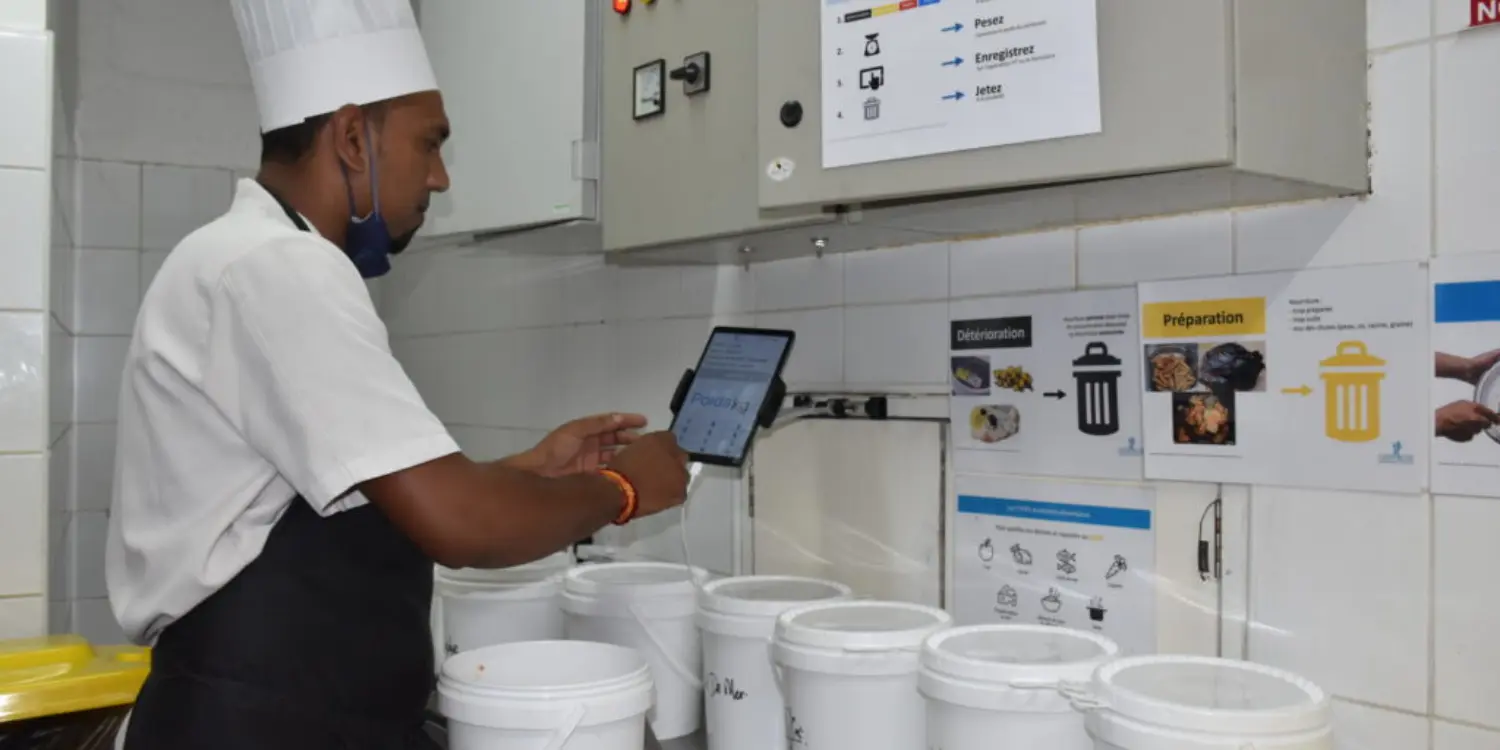
Indeed, after attending the training sessions in December 2021, the restaurant set up its recording station in early January. It consists of a tablet running the Food Intel Tech by LightBlue Consulting application, an electronic scale and various containers in which waste is sorted by category (fruit, meat, vegetables, etc.) The data, entered via the tablet, is instantly sent to the computer of executive chef Rakesh Roochan. It allows him to know the quantity of food wasted per cover and the types of food thrown away, and to identify the preparation stages that produce the most waste.
Using a dashboard, he tracks the volume of food waste produced by his kitchens on a daily basis. Over the past few weeks, he has trained every member of his brigade. “Today, it is part of our daily routine,” he says. “Thanks to the awareness-raising work, I see that team members are more careful, particularly when cutting produce, especially vegetables. Being able to quantify the waste makes us realize how much volume it represents,” he continues.
However, no corrective measures have been taken at this stage. Daily data recording will continue for a few more weeks in order to refine the diagnosis and identify the causes of waste. Only after this initial phase will concrete initiatives be implemented. “I am convinced that we can reduce our waste further, and above all make better use of the products we use. There are plenty of possible uses for peelings, while some vegetables don’t necessarily need to be peeled,” says Arnaud Dalais. These are all avenues to explore for reducing food waste.
As a reminder, this program, carried out at the initiative and with the financial support of the Representation of the International Organisation of La Francophonie for the Indian Ocean, is implemented by Cap Business Océan Indien, in collaboration with Living Labs Federation. Training, technology and technical support are provided remotely by LightBlue Consulting Ltd.
“This project, which we are carrying out in collaboration with Cap Business Océan Indien and Living Labs Federation, thanks to the support of the OIF Representation for the Indian Ocean, is very special to us. First of all, it is a unique opportunity to work simultaneously with 22 hotels and restaurants in six territories of the region. It is also the first time we have had the opportunity to pass on the knowledge we have acquired over a decade and our FIT technology in French, and we are delighted!” says Benjamin Lephilibert, CEO of LightBlue Consulting Ltd
This for-profit social enterprise works mainly on food waste prevention in Asia, Europe and the Indian Ocean. Benjamin Lephilibert is one of the creators of Food Intel Technology (FIT) and of The PLEDGE on Food Waste certification. To date, more than 2,000 professionals have been trained and made aware of this issue through the training provided by this Thailand-based company.

Lorem ipsum dolor sit amet, consectetur adipiscing elit. Ut elit tellus, luctus nec ullamcorper mattis, pulvinar dapibus leo.
