From rising sea levels, coastal erosion and increasingly extreme weather events, the impacts of climate change are already being felt, particularly across island territories that are often on the front line. Limiting global warming requires concrete action from both public authorities and private-sector businesses. This is why Cap Business Océan Indien has made Low-Carbon Strategies one of the cross-cutting markers of its 2021–2026 roadmap.
As major contributors to greenhouse gas emissions, businesses have a central role to play in addressing climate change. By adopting low-carbon pathways, they can reduce their environmental impact while also lowering their dependence on fossil fuels and mitigating risks that could undermine their financial stability. In doing so, they strengthen both their own resilience and that of their territories. Embarking on a decarbonisation strategy also enables businesses to meet the growing expectations of their stakeholders.
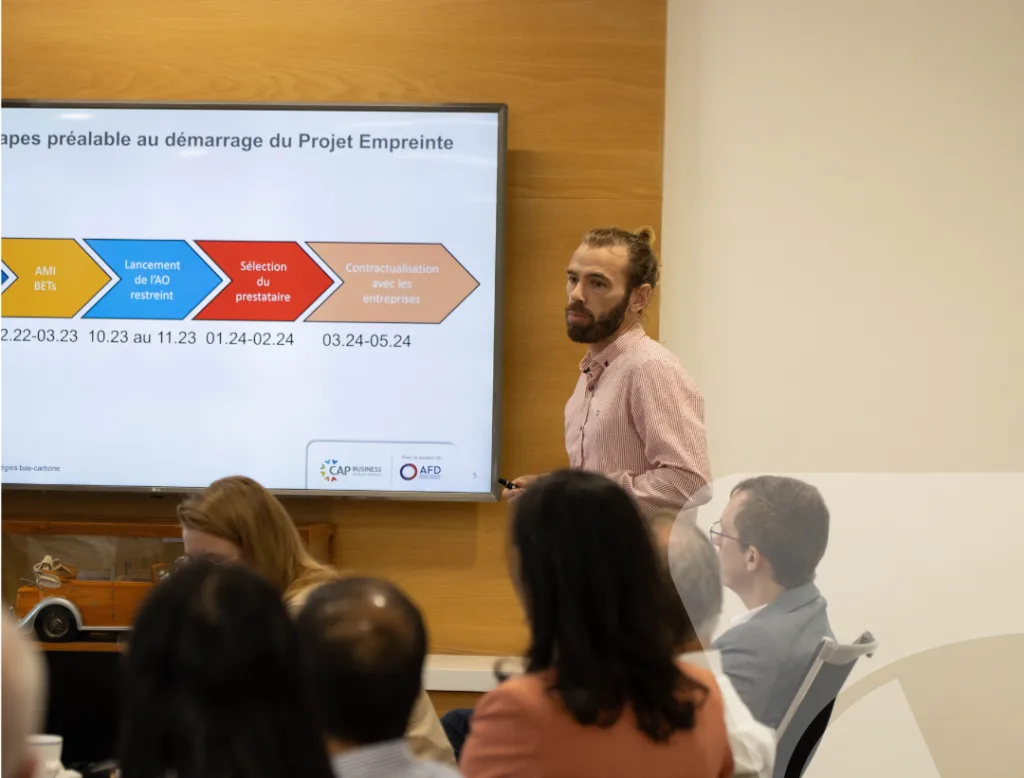
This project aims to help beneficiary businesses measure their carbon footprint and develop emissions reduction plans. Phase 1 enabled the association to raise awareness among 50 businesses in Mauritius and Madagascar about climate and energy challenges.
These pilot businesses received carbon footprint assessments covering Scopes 1, 2 and 3 across their entire value chains, using the Bilan Carbone® methodology. The project stands out for its rigorous approach, particularly its systematic inclusion of Scope 3 and the thorough documentation of the data, assumptions and emission factors used. The findings were then used to co-develop mitigation plans. As part of a practical training programme, the businesses’ designated representatives were also trained to use the Bilan Carbone® methodology, strengthening their in-house capacity.
Building on this initiative, Cap Business Océan Indien launched a 12-month Coaching Programme for the pilot businesses. The objective is to support beneficiaries through to their next carbon assessment, helping them move from diagnosis to action and measurable impact.
Following the success of Phase 1, Phase 2 will soon be launched for 11 businesses and business groups based in Comoros, Madagascar and Mauritius. The possibility of co-financing the beneficiaries’ carbon assessments under this phase is currently being explored.